
When I was a Boy Scout at the ripe old age of fifteen I loved to camp. I spent many a night sweating or freezing (or on special occasions both) depending on the weather. My fortifications against the elements were similar to my companions’; canvas tent, bulky sleeping bag and, well, that’s about it. Some of us, myself included, eventually upgraded to exercise mats; not the yoga mats found on store shelves today, but vinyl covered monstrosities stuffed with cheap foam. Mine was red as I recall and sported illustrated instructions for various stretches. So, there was that.
These days I’m neither a Boy Scout nor fifteen, but I do still love to camp. Fortunately for my 47 year old back and hips there are far better alternatives to sleeping on the ground than there were in 1987. Just as it has with many other outdoor gear implements advanced technology has bestowed upon us a dizzying array of options for getting our snooze on outdoors. Shall we discuss a few? Yes. Yes we shall.
If you’re in the market for a new sleeping pad the first question to answer is how you plan to use it. For example, if you’re ready to try your hand (and feet) at backpacking you’ll need a lightweight pad. On the other hand, if most of your adventures will involve base camping, or possibly float camping, there’s no reason to accept the decrease in comfort that comes with pads designed for backpacking.
The next question you must answer is how often you plan to use it. For occasional outings durability is a lesser concern, and if you don’t plan to camp in cold weather you most likely won’t need an insulated pad (though you still might decide you want one; more on that later).
And the final question; how much do you want to spend?
Exped, Jack’s Plastic Welding, Big Agnes, Aire, Thermarest, Nemo Equipment, Klymit…….The list of quality sleeping pad manufacturers is long with many highly recommended models, but there’s no way we can look at them all. I mean, we have camping to get to. Instead we’ll focus on two moderately priced options and consider how each one makes sense for a given camping style.
The old adage buy nice or buy twice applies in spades here. One night shivering or sleeping on the ground because you elected to save a few bucks by choosing a subpar sleeping pad will be enough for you to either abandon the outdoors or invest in a decent pad. In either case you’ll be out the cash you blew on a cheap one. Fortunately there’s no need to break the bank in order to achieve a good night’s sleep out there, so let’s do a little homework and get you snoozing.
Car/Base Camping: What’s great about car camping is, well, you have a car. Among other things this of course means you can skip the scale when packing for your trip. There are plenty of excellent car camping pads available in prices ranging from $60 to $400, but the one I use and highly recommend is the Aire Landing Pad. Let’s talk about why.
I’m hard on stuff. I don’t abuse or neglect my gear (okay, sometimes I abuse my gear), but I do expect it to withstand the rigors of an outdoor lifestyle. I need a pad that I can sleep on in the bed of my truck, strap across the front of my raft or lay flat in the bottom of a canoe when float camping. Believe it or not there are several pads that fill this bill, but the one I use is the Aire Landing Pad.
The Landing Pad is constructed with an open cell foam interior and PVC exterior with welded seams. This means even if the exterior suffers a cut or the valve leaks the pad will remain lofted. It’s made by Aire, manufacturer of top notch white water rafts, but before I continue I must say one thing. Aire did not invent this style of sleeping pad. That distinction goes to Jack’s Plastic Welding and their beloved Paco Pad. Jack makes his pads in New Mexico while Aire sources their production in China. I mention this because it’s very important to some consumers. I fully understand the need to support domestic manufacturing and do so whenever possible, but in this case I chose Landing Pads because they cost slightly over half as much as a comparable Paco Pad and I’m not independently (or for that matter dependently) wealthy. Stupid reality.
Paco Pads outlast Landing Pads, but Landing Pads are still amazingly tough and versatile. I will elaborate.
I have two Landing Pads and they are right at home in a truck bed, in a tent, or simply on the ground.
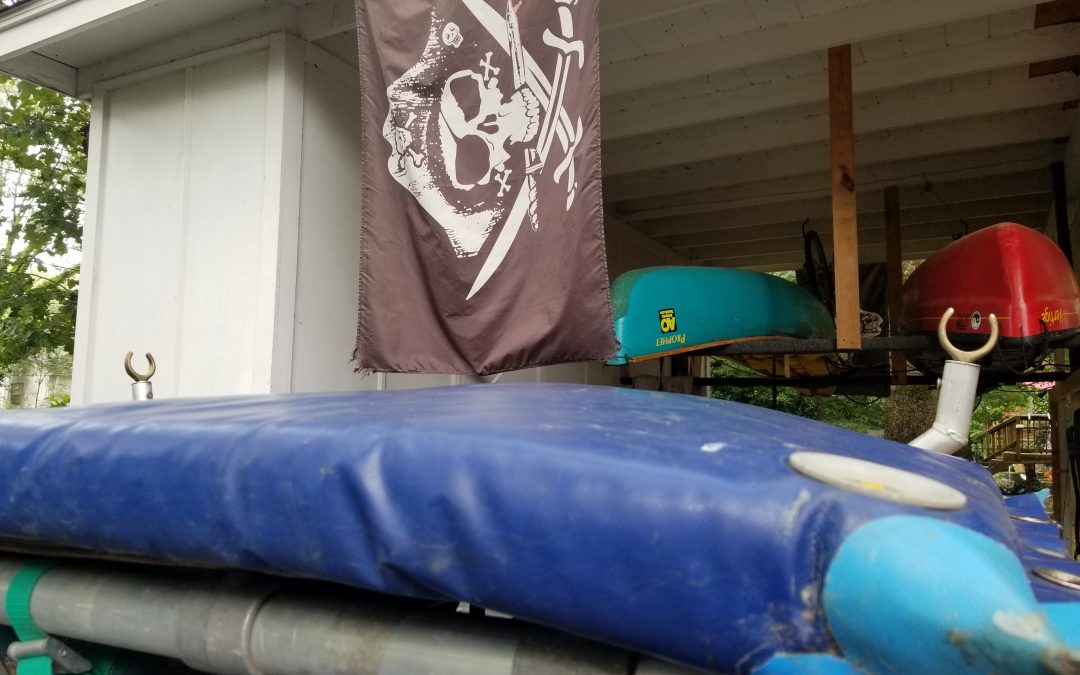
When float camping I cam strap them both across a table on the bow of my raft (as depicted in the featured image – I call it the princess pad) where they stay until we reach home sweet home for the night. In the interim there’s room for two or three passengers on the princess pad.
But, don’t they get wet???
Sure do! They also get wet when we float lazily down the river on them or use them to play in small rapids, but when we’re done we just drag, yes drag, them up the gravel bar and dry them off or let the sun do it for us. Try that with a traditional sleeping pad! They’re fair game for canoe camping too, but given their size and weight careful consideration may be in order, especially when tandem camping. As for backpacking, well, don’t do that. Landing Pads clock in at over ten pounds, and while they are designed to be deflated and rolled a rolled Landing Pad will be well over nine inches in circumference.
Backpacking: I really like backpack camping. It’s a great way to experience things I’d otherwise miss, and the challenge of fitting everything I need into a pack designed to hang from my back is one I relish. But, trading the truck or boat for trail shoes means it’s also time to trade the big heavy Landing Pads for something (much) smaller and lighter. I don’t backpack nearly as much as I boat, so when the time came to choose a backpacking sleeping pad cost was a major consideration. I just couldn’t justify the expense of a top of the line pad, but I knew I’d be out rambling in cool to cold temps so I needed to come up with an insulated model.
There’s an old saying that applies to outdoor gear. Light, good and cheap; pick two. This is certainly the case with regard to sleeping pads, but that doesn’t mean there aren’t quality options available at a reasonable price point. In my case that option turned out to be the insulated Klymit Static V. I have found it to be comfy, light and thus far durable. I use mine on the trail, gravel bar when canoe camping and as a loaner when the size of the car camping crew exceeds the number of Landing Pads in the gear room. It’s kept me warm in temps down into the twenties when paired with an adequate sleeping bag, and as a fairly acrobatic sleeper I’m happy to report it accommodates back and side sleepers (or in my case both) quite comfortably.
Klymit uses a pretty standard twist lock valve for quick and easy Inflation (a few puffs from the pie hole until the pad reaches the desired level of firmness) and I have yet to experience an overnight leak. When it’s time to pack up and hit the trail the Static V easily deflates and rolls to fit into its included stuff sack. Its packed size is a little fatter but shorter than a Nalgene bottle; plenty small to drop into a pack. As for weight, at 24 ounces it’s certainly not the lightest pad on the market, but at its price point (regularly available in the $60 to $75 range) it’s an excellent value.
We could talk about weight and R value and other fancy stuff, but if you’re reading this my guess is you’re just considering an entrée into backpacking, and if so you’d be hard pressed to beat the Insulated Static V. If you become the next Andrew Skurka (he’s a famous backpacker) you’ll eventually want to upgrade $$$, but the Insulated Static V is a versatile pad that will give you many years of enjoyment.
These two pads are likely all I’ll ever need for my outdoor exploits, and that’s largely because when it comes to gear I take care to avoid unitaskers. For example, I don’t always need an insulated pad, but sometimes I do, and I can sleep just fine on one even when conditions don’t require it. On the other hand, if I do need an insulated pad but don’t have one I’ll literally be an unhappy camper. So, rather than buying an uninsulated pad then later wishing I had an insulated pad……….you get the idea.
Finally, there’s no such thing as a one size fits all sleeping pad. That’s why there are hundreds available at many different price points. Find the one that’s right for you. One more thing; when making your decision don’t forget to consider the warranty. The best warranty is one you’ll never need, but a weak warranty could mean a weak product (not always). If you need a little help sorting it out drop me a line when your nap’s over.
See you out there!
Deuce


